How Do Earthquake Alerts Actually Work?
Your phone buzzes. An earthquake notification: a magnitude, a place name, maybe a distance. Behind that single buzz sits a chain of decisions — who detected the quake, who confirmed it, and whether it was worth interrupting your evening for. Most alert apps never explain that chain. We'd like to explain ours.
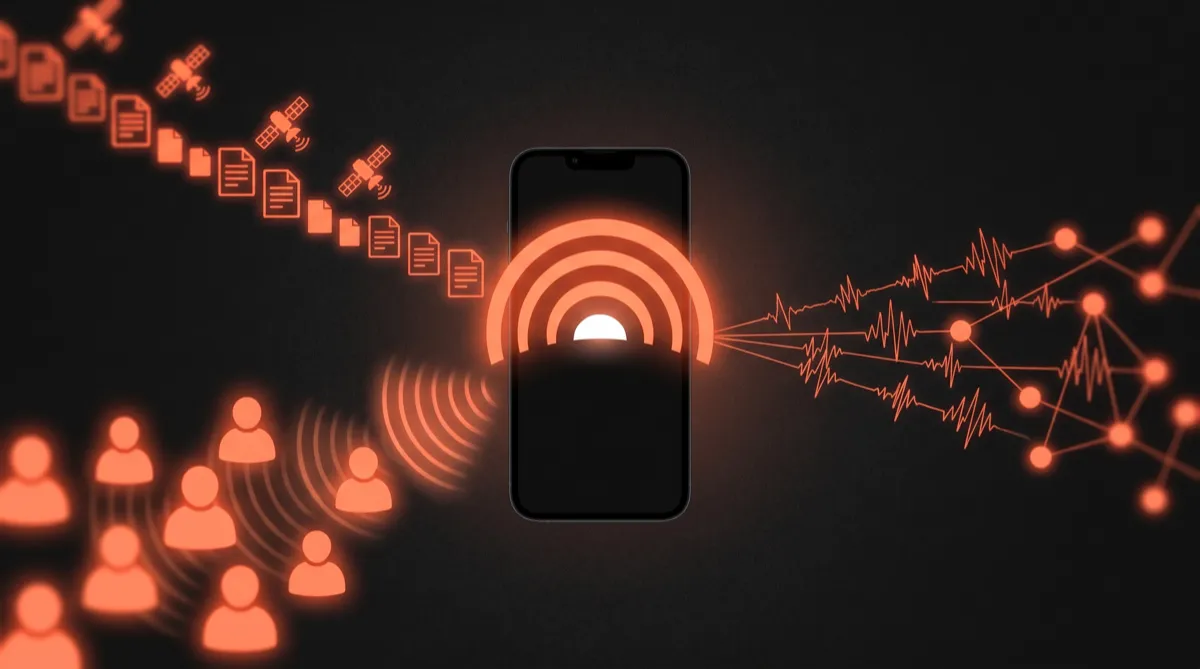
Every earthquake alert GeoShake sends comes from one of three distinct streams: official agency catalogs, community felt reports, and our own seismometer network. Each stream answers a different question, moves at a different speed, and deserves a different kind of trust. Most of the confusion around earthquake notifications disappears once you separate them.
This post walks through all three — including the awkward parts: why one data source in our app deliberately never notifies you, and why we sometimes send two notifications for the same earthquake on purpose.
Three streams, one goal
Open the GeoShake app and every event you see arrived through one of these pipelines:
- Official catalog alerts — earthquakes published by official seismological agencies. Reviewed, authoritative, and the slowest of the three.
- Community alerts — generated when several people in the same area independently tap "I felt an earthquake" within a short time window.
- GeoShake network events — detections by our hardware seismometer network, pushed in real time.
The goal is the same for all three: tell you about shaking that matters, as fast as possible, without crying wolf. But they trade speed against authority very differently. The network is the fastest and the most local. The catalogs are the most authoritative. And community reports capture the one thing instruments can't measure — what people actually felt.
Most earthquake apps are built on exactly one of these sources — we compared the major ones in our review of earthquake alert apps. GeoShake runs all three in parallel, which is exactly why its notifications deserve a proper explanation.
Stream 1: Official catalogs
This is the backbone stream: earthquakes published by official agencies — USGS globally, AFAD for Türkiye. When an agency publishes an event, we estimate the quake's felt radius from its magnitude and depth, capped at 500 km, and deliver the alert to users whose chosen alert area intersects that radius. Both conditions have to hold: a small quake far away won't reach you even with a generous radius setting, because its own felt area never gets anywhere near you.
Severity affects delivery, too. Anything M5.0 and above goes out as a high-priority, time-sensitive notification — the kind that is allowed to break through focus modes — because at that size, "check this later" is the wrong default.
Agencies also revise their numbers as more data arrives, and we had to decide what to do about that. Our rule: we only re-notify when the revision genuinely changes the picture — a magnitude change of 0.3 or more, or a crossing of a whole-magnitude line (a 4.9 becoming a 5.1 is news; a 4.5 becoming a 4.6 is not). And the updated notification replaces the earlier one instead of stacking on top of it. Your lock screen is not a changelog.
Why EMSC events never notify you
Here's the honest part. Browse the app's feed or map and you'll also see events attributed to EMSC, the European-Mediterranean Seismological Centre. Those events are real, and we show them for completeness — but they deliberately never trigger notifications.
The reason is duplication, not quality. EMSC largely reports the same physical earthquakes that USGS and AFAD publish, with slightly different timing, coordinates, and magnitudes. If every source notified independently, one real quake would buzz your phone two or three times, with numbers disagreeing in the decimals. We'd rather not double-alert you — so EMSC stays display-only, and notification duty falls to the primary agencies.
Stream 2: Community reports
The app has an "I felt an earthquake" button, and yes — those reports can turn into alerts for other people. But there is a rule we treat as non-negotiable: a single report never triggers an alert. Not yours, not anyone's. One tap can't page a city.
A report only becomes an alert when it clusters with enough other reports, close together in both space and time. Even then, the cluster has to pass scoring that quietly weighs each reporter's track record — accounts have cooldowns, bursts that look scripted are discarded, and outliers are rejected. The intensity number that ends up in the alert is computed defensively too: a distance-weighted median with outlier rejection, so one exaggerated report can't drag the average.
Two details here that we think more alert systems should copy. First, if you're one of the reporters, you receive a confirmation, not an alarm — you already know it shook; the alert is for the people around you. If the event escalates, you're alerted again. Second, the most severe tier of community alert is always delivered, even through mute: that tier is reserved for shaking strong enough that we accept no opt-out.
Stream 3: The GeoShake network
The third stream comes from our own hardware: small seismometers in homes, schools, and offices, continuously measuring ground acceleration. A single station spiking means very little — to one sensor, a slammed door looks a lot like a small earthquake. So the network only declares an event when multiple stations confirm the same shaking. One sensor's bad day never becomes your notification.
When that confirmation happens, the notification goes out within seconds. This is the stream that can beat the catalogs by minutes, because agencies publish reviewed solutions and reviewing takes time. Those minutes matter for a simple physical reason: seismic waves travel at fixed speeds, so fast information is the only kind that can arrive ahead of the shaking — the full physics is in our earthquake early warning guide.
What the alert contains is deliberately conservative. Every network notification carries the number of detecting stations and an intensity class derived from actual measured ground acceleration (PGA) — measurements, not estimates. A preliminary magnitude, always labeled ~M, is attached only when the solution is well-constrained: at least three detecting stations and a tight location fit. Below those gates, the notification ships with measured quantities only. We never show a number we can't stand behind — and every network estimate is automatically compared against the official agency solution once it appears. The tilde is there to be earned away, not asserted away.
Tapping a network alert can also open a countdown that estimates the seconds until the shaking reaches your location. What that screen can honestly promise — and what it can't — deserves an article of its own.
Why you sometimes get two notifications for one quake
Put streams one and three together and you'll notice a pattern after a real earthquake near the network: a fast notification within seconds, reporting what our stations measured — then a second one minutes later carrying the official agency solution. That's not a bug. The pairing is deliberate.

Didn't we just spend a section explaining that we refuse to double-alert you about EMSC? Yes — and the distinction matters. An EMSC notification would be the same kind of information twice: another catalog's take on a quake you were already told about. The network-then-agency pair is two different measurements: what our instruments recorded near the event within seconds, and what the agency concluded after review. Shown side by side, they tell you something neither could alone — how quickly the first answer arrived, and how well it held up against the official one.
If the two numbers differ a little, that's expected rather than embarrassing: one is a preliminary estimate from a young sensor network, the other is a reviewed solution from a seismological agency. When they agree, you'll see that too — the comparison sits right there on your lock screen.
What's inside a notification
Different streams carry different fields — here's the walk-through of what each alert actually contains:
| Official catalog | Community | GeoShake network | |
|---|---|---|---|
| Triggered by | An agency publishing a reviewed solution | Multiple felt reports clustering in space and time | Multiple stations confirming shaking |
| Magnitude | Yes, with its type; significant revisions replace the alert | No — people report what they felt, not magnitude | ~M (preliminary), only when well-constrained; otherwise omitted |
| Intensity | — | Average reported intensity, outlier-resistant | Measured class derived from peak ground acceleration |
| Location & time | Epicenter coordinates, depth, origin time, place name | Estimated center of the report cluster | Estimated epicenter and origin time |
| Also carries | Source agency, tsunami flag | Report count, alert tier | Detecting station count |
One practical consequence worth knowing: the app's alert settings don't apply globally — each setting governs specific streams. The community alert level, for example, filters community alerts only; it has no effect on catalog or network events. The full map of which setting controls which stream is worth an article of its own.
Frequently asked questions
Why did I get two notifications for the same earthquake?
If one alert arrived within seconds and the other minutes later, that's the deliberate pairing of our network and the official catalogs: the first is what GeoShake stations measured in real time, the second is the agency's reviewed solution. They're two different measurements of one event, shown side by side — not an accidental duplicate.
Why don't EMSC events send notifications?
EMSC events appear in the app's feed and map, but they're display-only by design. EMSC largely covers the same physical earthquakes as USGS and AFAD, so notifying from every source would mean two or three alerts for one quake. We show EMSC data for completeness and reserve notifications for the primary agencies.
How fast are earthquake alerts?
It depends on the stream. GeoShake network events are pushed within seconds of multi-station confirmation. Official catalog alerts typically arrive minutes after the quake, because agencies take time to publish a reviewed solution. Community alerts form as quickly as felt reports cluster together. One honest caveat: every alert describes an earthquake that has already started — if you're very close to the epicenter, shaking can reach you before any notification does.
That's the whole pipeline — three streams, each honest about what it knows and how it knows it. The next posts in this series go deeper on the countdown screen, the story behind the ~M tilde, and exactly which setting controls which alert.
Want these alerts on your phone?
The free GeoShake app carries all three alert streams described in this post.
Get earthquake insights in your inbox
One short email a month — new guides, network updates, real detection stories. No spam, unsubscribe anytime.