GeoShake vs Raspberry Shake: Cost, Accuracy & Use Case Comparison
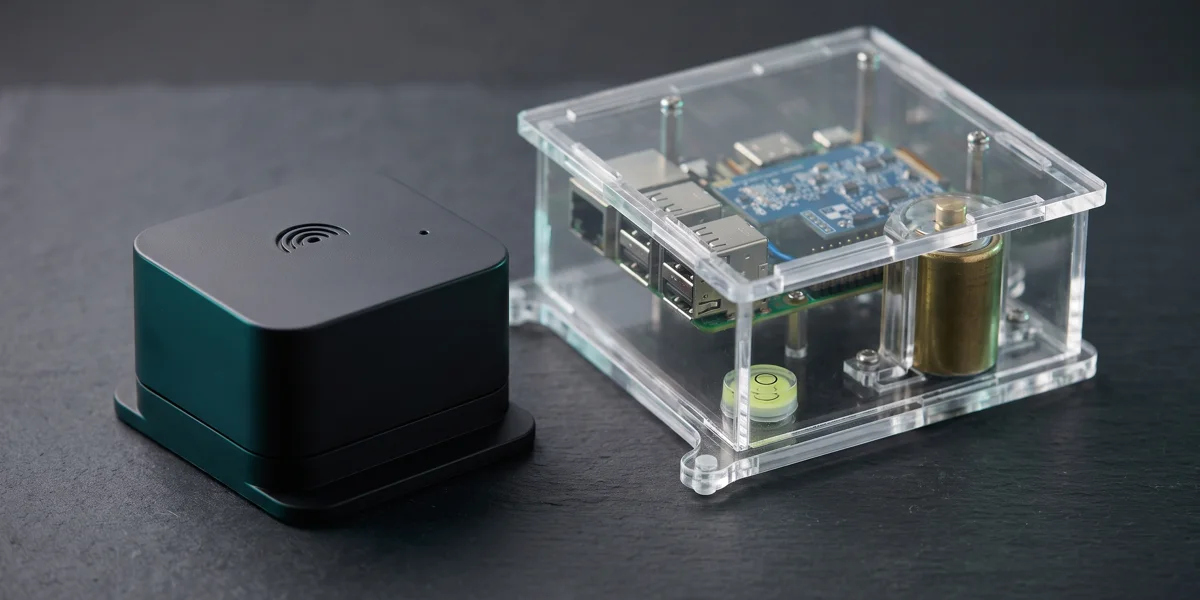
GeoShake T1 and Raspberry Shake are fundamentally different devices built for different goals. GeoShake T1 (€199, taxes and worldwide shipping included, open source firmware) is a premium earthquake early warning sensor: it uses 4× LSM6DSO MEMS accelerometers on an ESP32-S3, sampling at 104 Hz, secured with TLS, and transmits Peak Ground Acceleration data via MQTT in milliseconds — optimizing for speed and alarm delivery, with a native mobile app to close the loop. Raspberry Shake ($584.99–$1,404.99) is a scientific seismograph: geophone-based, records full waveform data in miniSEED format for research-grade analysis. The core difference is purpose — GeoShake optimizes for speed (alert), Raspberry Shake for precision (data). Even at €199, GeoShake is still roughly 60% cheaper than the entry-level Raspberry Shake 1D and about 80% cheaper than the Raspberry Shake 3D — and the price advantage makes dense early-warning networks feasible in ways that a handful of research instruments cannot match. For community earthquake early warning, the two can even complement each other: GeoShake as the alarm system, Raspberry Shake as the data recorder.
If you're looking for a home earthquake sensor, you've probably come across two names: GeoShake and Raspberry Shake. They both detect earthquakes. They both involve community networks. But they're fundamentally different devices designed for different purposes — and they sit at very different price points.
This guide breaks down exactly how they compare so you can pick the right one for your needs — whether you're a homeowner who wants earthquake alerts, a maker building a DIY seismic station, or a citizen scientist contributing to seismological research.
TL;DR — Quick Comparison
GeoShake T1
Taxes and worldwide shipping included
- Earthquake early warning focus
- 4× MEMS accelerometers
- MQTT real-time alerting
- Open source firmware (GPL-3.0)
- 90-second plug-and-play setup
Best for: Homeowners, schools, community networks, makers — and researchers who need coverage rather than one deep station
Raspberry Shake
- Scientific seismograph focus
- Geophone + accelerometer models
- Full waveform data recording
- Raspberry Pi based
- Research-grade data output
Best for: Single-station research, waveform teaching, seismology enthusiasts
What Are These Devices?

GeoShake T1
GeoShake T1 is an open-source earthquake early warning sensor. Its core mission is speed: detect a seismic event, quantify its intensity using Peak Ground Acceleration (PGA), and alert the network in milliseconds. Built around an ESP32-S3 microcontroller with four LSM6DSO MEMS accelerometers sampling at 104 Hz, it transmits PGA data via MQTT — meaning the alert travels at the speed of light, not the speed of seismic waves.
It's designed for anyone who wants reliable, real-time earthquake detection at home without paying research-grade prices. No Raspberry Pi required, no complex configuration, no subscription fees.

Raspberry Shake
Raspberry Shake is a family of personal seismographs built on the Raspberry Pi platform. It comes in multiple models — from the basic 1D (single geophone) to the 4D (geophone + 3-axis accelerometer). Raspberry Shake records full seismic waveforms in standard miniSEED format, making the data directly usable by professional seismologists and research institutions.
It's designed for people who want to study earthquakes in detail — not just detect them, but analyze the waveforms, measure frequencies, and contribute research-grade data to the global seismological community.
Head-to-Head Specs
| Feature | GeoShake T1 | Raspberry Shake |
|---|---|---|
| Price | €199 (all-in) | $584.99–$1,404.99 (turnkey) |
| CPU | ESP32-S3 (240 MHz dual-core) | Raspberry Pi (1.5 GHz quad) |
| Sensors | 4× sensor-fusion accelerometer array LSM6DSO MEMS, averaged before detection |
Geophone ± 3-axis accelerometer |
| Sample Rate | 104 Hz | 100 Hz (configurable) |
| Data Output | PGA value (instant alert) | Full waveform (miniSEED) |
| Protocol | MQTT (millisecond latency) | SeedLink / HTTP |
| Connectivity | WiFi + Bluetooth LE 5 | Ethernet — Raspberry Shake advises against the Pi’s built-in Wi-Fi |
| Setup Time | 90 seconds | 15–30 minutes |
| Separate computer | None — single embedded device, no microSD | Raspberry Pi + microSD card |
| Power | ~1 W | 1.5 W running · 2.8 W at startup |
| Power supply | 5 V / 1 A | 5.1 V / 2.5 A |
| Open Source | Firmware GPL-3.0 | Proprietary |
| Real-time data feed | Free and open (SeedLink + API) | $12/year |
| Smart home | Home Assistant | None |
| Network type | Hybrid — hardware nodes + phone sensors in one pool | Dedicated hardware only |
| Primary Goal | Early warning + post-earthquake shaking map | Scientific recording |
Cost Breakdown
The price difference is meaningful — but the story is more nuanced than "cheap vs expensive." Both devices are in premium territory; GeoShake just sits at the accessible end of that range.
Total Cost of Ownership (Year 1)
Key insight: For roughly the price of a single Raspberry Shake 3D, you could
deploy more than five GeoShake T1 sensors across a community — enough to form a
meaningful local early-warning mesh instead of a single recording station.
Prices are the turnkey (pre-assembled) configurations, which is the fair comparison against a
T1 that arrives ready to mount. Raspberry Shake also sells DIY kits at lower prices that require you to
supply and assemble a Raspberry Pi. GeoShake's €199 includes VAT and worldwide shipping; import duties
vary by country and remain the buyer's responsibility. Raspberry Shake's cloud services are free; only
their Live Data Feeds carry a $12/year fee.
Neither device charges ongoing subscription fees. Both use WiFi for data transmission. The key difference in total cost is purely in the hardware — GeoShake is roughly 60% cheaper than the entry-level Raspberry Shake 1D and about 80% cheaper than the Raspberry Shake 3D — comparing turnkey to turnkey — while still delivering a premium 4-sensor MEMS array, 104 Hz sampling, and MQTT alerting out of the box.
A note for academic and institutional buyers: GeoShake offers dedicated pricing for schools, universities, research labs, and bulk community deployments. Reach out via our contact form for a quote tailored to your project.
Detection Accuracy & Sensitivity

GeoShake T1 · proof masses on silicon springs
Raspberry Shake · coil, magnet and spring
This is where the comparison gets nuanced, because these devices measure different things in different ways.
GeoShake: Speed Over Detail
GeoShake doesn't try to record the full earthquake waveform. Instead, it uses the STA/LTA algorithm to detect sudden changes in ground acceleration. When it detects an event, it sends the Peak Ground Acceleration (PGA) value — a single number that tells you how intense the shaking is, measured in units of gravity (g).
The 104 Hz sample rate is fast enough to capture the frequency range of damaging seismic waves (typically 0.1–20 Hz).
Why four sensors instead of one
A single MEMS accelerometer is a noisy instrument. Its output carries the ground motion you want plus the chip's own electronic noise — and at the amplitudes a modest earthquake produces, that noise is the only thing standing between detection and silence.
The T1 carries four LSM6DSO accelerometers on one board and averages them before the detector sees anything. This works because of an asymmetry: each chip's electronic noise is independent, while a real ground motion moves all four identically. Averaging N sensors therefore suppresses the noise by √N while leaving the signal untouched — a factor of two for four sensors.
That is not a marketing figure, it is measurable. The LSM6DSO datasheet gives a noise density of roughly 110 µg/√Hz, which across the T1's measurement band predicts about 0.0078 m/s² of noise per axis for a single chip — and 0.0039 m/s² after quad averaging. Seven days of field data from three T1 stations, roughly 1.7 million one-second windows, measure 0.00385 m/s². Prediction and measurement agree to within about one percent.
In practical terms, halving the noise floor is worth roughly 0.3 magnitude units of extra reach at any given distance. An earthquake that would sit just below the trigger threshold on a single-sensor design clears it on the T1.
The economics are the point. Three extra MEMS chips cost a few dollars. Buying the same factor-of-two improvement from one quieter sensor costs vastly more, and buying it from a geophone means changing instrument class altogether — along with the price, the size and the fragility that come with a moving coil on a spring. Sensor fusion is simply the cheapest signal-to-noise on the market, which is exactly what a network that needs to be dense can afford.
And its limit, stated plainly. √N has sharply diminishing returns: going to eight sensors would buy only another factor of 1.41. Quad averaging does not turn a MEMS array into a geophone, and it is not meant to. It buys the margin that makes a €199 instrument genuinely useful for the earthquakes people feel — without pretending to compete for the microquakes a geophone was built to hear.
Raspberry Shake: Detail Over Speed
Raspberry Shake records continuous waveform data in miniSEED format — the industry standard for seismological data. This means every wiggle, every frequency component, every nuance of the seismic signal is captured and stored.
The geophone models (1D, 4D) are sensitive enough to detect distant earthquakes thousands of kilometers away — something MEMS accelerometers typically can't do. For local events, the accelerometer models provide strong-motion data similar to what GeoShake captures.
Think of it this way: GeoShake is a smoke detector — it tells you there's a fire NOW. Raspberry Shake is a surveillance camera — it records everything for later analysis. Both valuable, but for different reasons.
Who Should Buy What?
Choose GeoShake if you want...
- Both halves of the earthquake — seconds of warning before the shaking reaches you, and an honest measurement of what actually happened after it stops
- Your own number, not a regional estimate — how hard the ground moved at your address, rather than a value interpolated from a station 40 km away
- A network dense enough to matter — €199 all-in puts five sensors across a neighbourhood where one research station would go
- Hardware and phones in one pool — dedicated nodes and phone sensors feed the same correlation engine, so coverage appears where people are on the day it counts
- Earthquake-aware home automation — Home Assistant integration: lights on, gas valve closed, the moment shaking is detected
- A station that doesn't quietly die — one embedded device, no Raspberry Pi and no microSD card to corrupt; 90 seconds from box to network over Bluetooth
- Free and open by default — GPL-3.0 firmware you can audit, and real-time data at no cost
Choose Raspberry Shake if you want...
- Full waveform recording for scientific analysis
- Distant earthquake detection — record events from thousands of km away
- miniSEED data export compatible with professional seismology tools
- Classroom/educational use where studying waveforms is the goal
- Research contributions to the scientific community via FDSN standards
Network & Community

Both devices feed into community networks, but with different architectures:
GeoShake Network
The GeoShake network is optimized for speed. Sensors transmit PGA data via MQTT with millisecond latency. When multiple sensors in an area report elevated PGA values, the network can triangulate the event and push alerts to all users — potentially before the destructive S-waves arrive.
The network's strength grows with density. Because GeoShake sensors cost a fraction of research-grade instruments, it's feasible to create hyper-dense networks — sensors every few blocks — which dramatically improves detection speed and location accuracy.
Raspberry Shake Network
The Raspberry Shake network (ShakeNet) is a global network of personal seismographs. It's primarily designed for data sharing — stations appear on a map, and their waveform data can be accessed by anyone. Many professional seismologists use ShakeNet data to supplement their own research.
ShakeNet's strength is in data quality — each station provides continuous, research-grade waveform data that can be analyzed using standard seismological tools like ObsPy, SeisComP, and SWARM.
Can You Use Both?

Absolutely. In fact, using both gives you the best of both worlds:
The Ideal Setup
- GeoShake T1 acts as your alarm system — it detects the earthquake and alerts you in real-time via the GeoShake network
- Raspberry Shake acts as your data recorder — it captures the full waveform so you can analyze the event later
- GeoShake tells you "earthquake happening NOW" → Raspberry Shake tells you "here's exactly what happened"
Many serious citizen seismologists run both devices side by side. GeoShake handles the time-critical alerting; Raspberry Shake handles the deep data analysis.
The Verdict
There's no single "best" earthquake sensor — it depends on your goals:
| Your Goal | Best Choice | Why |
|---|---|---|
| I want earthquake alerts at home | GeoShake T1 | Built for millisecond alerting, with a phone app tied to your own sensor |
| I want to know how hard it shook at my address | GeoShake T1 | Measures peak ground acceleration where you live, instead of interpolating from a station 40 km away |
| I want to deploy sensors across my community | GeoShake T1 | 5+ sensors for the price of one Raspberry Shake 3D |
| I want my home to react when the ground moves | GeoShake T1 | Home Assistant automations trigger the moment shaking is detected |
| I want to study a single waveform in depth | Raspberry Shake | Full miniSEED records, geophone sensitivity, ObsPy-ready |
| I’m teaching a class about seismic waves | Raspberry Shake | One instrument, deep detail — P/S phase picking on real records |
| I’m running a school network experiment | GeoShake T1 | Five sensors for one budget — triangulation and travel-time between buildings |
| I want open source firmware I can modify | GeoShake T1 | GPL-3.0 firmware, published source and enclosure designs |
| I want the most comprehensive setup | Both | Warning + measurement + archive |
For most people the choice is not really about sensitivity. It is about what you want the instrument to do on the day of an earthquake. A Raspberry Shake records that day beautifully and lets you study it long afterwards. A GeoShake T1 is built to tell you something in the seconds before the shaking arrives — and then to answer the question everyone actually asks once it stops: how hard did it shake here? At €199 with VAT and worldwide shipping included, it is priced so that the answer can come from your own street rather than a station 40 km away. That is the whole argument. Not a better sensor — enough of them.
Frequently Asked Questions
What is the main difference between GeoShake and Raspberry Shake?
GeoShake T1 (€199, taxes and worldwide shipping included) is a premium open-source earthquake early warning sensor focused on detecting seismic events and alerting communities via MQTT. Raspberry Shake ($584.99+) is a research-grade seismograph that records full waveform data for scientific analysis. GeoShake prioritizes speed and real-time alerting; Raspberry Shake prioritizes waveform detail for post-event research.
Is GeoShake as accurate as Raspberry Shake?
For earthquake early warning detection, GeoShake is highly effective — its quad LSM6DSO accelerometer array reliably detects seismic events. However, for detailed seismological research requiring full waveform analysis, Raspberry Shake's geophone sensors provide more detailed data. Each device is optimized for its intended purpose.
Can I use GeoShake and Raspberry Shake together?
Yes! Many citizen scientists use both. GeoShake provides fast alerting — it's your alarm system. Raspberry Shake records detailed data — it's your data recorder. Together, they give you complete earthquake monitoring: real-time alerts plus deep analysis.
Which sensor should I buy for home earthquake detection?
If your goal is real-time earthquake early warning for your home and community, GeoShake T1 (€199) is the best choice — a premium 4-sensor MEMS array with MQTT alerting and a native mobile app, for a fraction of the cost of research-grade alternatives. If you want detailed seismological research capabilities, invest in a Raspberry Shake. For most homeowners who simply want to know when an earthquake is happening, GeoShake offers the best value.
10% off the GeoShake T1
Made it to the end? Use this code at checkout. VAT and worldwide shipping are already included in the price — this comes off the top.
Enter the code in the promotion field at checkout.
Ready to start detecting earthquakes?
Get the GeoShake T1 — a premium earthquake early warning sensor for €199, taxes and worldwide shipping included.
Related Articles
How Earthquake Early Warning Works: P-Waves vs S-Waves
Understand the science behind early warning — the speed gap between P-waves and S-waves that gives you precious seconds.
DIY Seismograph with ESP32: How to Build a Home Earthquake Sensor
Learn about PGA, the GeoShake T1 architecture, and how to build your own seismic station.
Is a Home Earthquake Sensor Worth It? Costs, Benefits & What to Expect
A no-hype breakdown of whether a home earthquake sensor is worth the investment for your safety.
Sources & References
- Raspberry Shake Official Site — Product specifications, pricing, and technical documentation for the Raspberry Shake personal seismograph lineup
- IRIS — Incorporated Research Institutions for Seismology — Global seismic network standards, instrument sensitivity benchmarks, and citizen seismology resources
- STMicroelectronics LSM6DSO Datasheet — Official datasheet for the 6-axis iNEMO inertial module (accelerometer + gyroscope) used in the GeoShake T1, including noise density, full-scale range, and ODR specifications
- Espressif ESP32-S3 Technical Reference — Microcontroller specifications, Wi-Fi/BLE connectivity features, and processing capabilities relevant to the GeoShake T1 platform
Get earthquake insights in your inbox
One short email a month — new guides, network updates, real detection stories. No spam, unsubscribe anytime.