How Many Seconds of Warning Do You Actually Get Before an Earthquake?
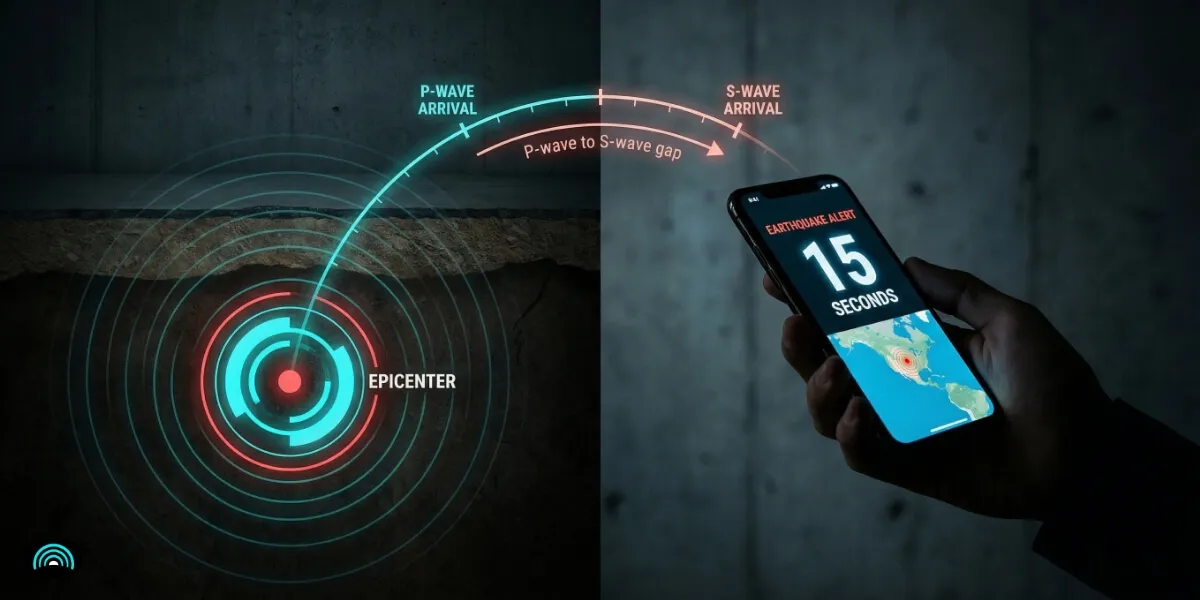
Earthquake early warning gives you between 5 and 90 seconds of warning depending on three factors: distance from the epicenter, sensor network density, and alert processing speed. At 10–30 km from the epicenter, realistic warning time is 3–8 seconds. At 30–70 km, you get 8–18 seconds. At 70–150 km, expect 18–45 seconds. Beyond 150 km, up to 90 seconds is possible. Even 2–3 seconds is enough to Drop, Cover, and Hold On — the action proven to reduce earthquake injuries. Japan's network, with sensors every 20 km, achieves detection in about 3 seconds. Sensor density is the most controllable variable: every 10 km closer a sensor is to the epicenter adds roughly 1.5–2 seconds of warning for everyone downstream. Community networks like GeoShake exist precisely to close these coverage gaps. The cruel irony of EEW is that those nearest the epicenter get the least time — which is why every sensor placed in a coverage gap matters.
"How much time will I have?" — It's the first question everyone asks about earthquake early warning. The answer isn't a single number. It's a range, and understanding that range could be the difference between being caught off-guard and being safely under a table when the shaking hits.
Earthquake early warning (EEW) systems don't predict earthquakes. They detect them the instant they begin and race to alert you before the destructive waves reach your location. The amount of time you get depends on physics, geography, and the sensor network around you.
Here's exactly how much warning time you can realistically expect, what determines it, and how community sensor networks like GeoShake are working to give everyone more of it.
The Short Answer: 5 to 90 Seconds
For most people living in earthquake-prone areas, the realistic warning window is 5 to 60 seconds. In rare cases — when the earthquake is very far away but still strong enough to affect you — you might get up to 90 seconds.

But here's the thing most people don't realize: those closest to the epicenter — who need the warning most — get the least time. And those far away get the most time but experience the weakest shaking. This is the fundamental trade-off of earthquake early warning.
"The cruel irony of earthquake early warning: the people who most need it get the least of it. That's why sensor density matters — every second we shave off detection time is a second given to someone near the epicenter."
Why Warning Time Varies So Much
Three factors determine how much warning time you get. Understanding them helps you set realistic expectations — and take action to improve your odds.
Factor 1: Distance from the Epicenter
This is the single biggest factor. Every earthquake generates two main types of seismic waves:
- P-waves (Primary waves) — travel at 5–8 km/s, cause mild vibration, arrive first
- S-waves (Secondary waves) — travel at 3–5 km/s, cause violent shaking, arrive later
The gap between when P-waves arrive and when S-waves arrive grows with distance. EEW systems detect the P-waves and alert you before the S-waves hit. At 50 km from the epicenter, that gap is roughly 10–12 seconds. At 200 km, it becomes 50–60 seconds.

Factor 2: Sensor Network Density
Here's what most articles about EEW don't tell you: the warning clock doesn't start ticking until a sensor detects the earthquake. If the nearest sensor is 50 km from the epicenter, you've already lost 8–10 seconds of potential warning time because the P-waves had to travel to the sensor first.
This is why sensor density is critical:
- Japan's network — sensors every 20 km → detection in ~3 seconds
- US ShakeAlert — sensors every 50–100 km → detection in ~5–10 seconds
- Areas with no EEW — no sensors → no warning at all
Every 10 km closer a sensor is to the epicenter gives roughly 1.5–2 seconds more warning to everyone downstream. This is exactly why community networks matter — a GeoShake T1 sensor (€199) in the right location can add seconds of warning for thousands of people.
Factor 3: Alert Processing & Delivery Speed
Once a sensor detects the P-wave, the system has to:
- Confirm it's a real earthquake (not a truck, slam, or footstep)
- Estimate the magnitude and location
- Transmit the alert to your device
Japan's UrEDAS system does this in 2–3 seconds. ShakeAlert in the US takes about 4–6 seconds. GeoShake's MQTT-based system targets under 2 seconds from detection to alert, because the sensor sends raw PGA data directly without waiting for multi-station confirmation.
Then there's the "last mile" — how fast the alert reaches your phone. Push notifications can take 1–3 seconds. That's why local alerting (a sensor in your own home triggering an alarm instantly) can be faster than any cloud-based system.
Warning Time by Distance: The Complete Table
Here's a realistic breakdown of expected warning times, assuming a well-functioning EEW system with 3-second detection time:
| Distance | P-S Gap | Realistic Warning | Shaking Intensity | What You Can Do |
|---|---|---|---|---|
| 0–10 km | 1–2 sec | 0–2 sec | Extreme (VIII–X) | Automated systems only |
| 10–30 km | 2–5 sec | 3–8 sec | Very Strong (VII–IX) | Drop, Cover, Hold On |
| 30–70 km | 5–12 sec | 8–18 sec | Strong (VI–VIII) | Move to safe zone, stop vehicle |
| 70–150 km | 12–30 sec | 18–45 sec | Moderate (V–VII) | Evacuate ground floor, secure valuables |
| 150–300 km | 30–60 sec | 45–90 sec | Light–Moderate (IV–VI) | Full preparation, complete evacuation possible |
Important note: "Realistic Warning" accounts for detection time (3 sec), processing time (2 sec), and alert delivery (1–2 sec). The raw P-S gap would be longer, but those overhead seconds are eaten by the system itself.
What You Can Do With Each Second
People often underestimate how much can be accomplished in a few seconds. Here's what happens in the critical moments after an earthquake alert:

Drop, Cover, Hold On
A trained person can get under a desk or table in under 2 seconds. This single action prevents the most common earthquake injury — being hit by falling objects.
Elevators Open & Stop
Smart elevator systems stop at the nearest floor and open doors. Being trapped in an elevator during a major earthquake is extremely dangerous.
Gas Lines Shut Off
Automatic gas shutoff valves close, preventing fires — the most deadly secondary effect of earthquakes. Industrial machinery enters safe mode.
Trains Brake & Surgeons Pause
High-speed trains initiate emergency braking. Japan's Shinkansen has never had a fatality partly due to EEW integration. Surgeons secure patients and retract instruments.
Workers Exit Danger Zones
Construction workers move away from cranes and heavy equipment. School children get under desks. People move away from windows and shelving.
Full Evacuation Possible
Ground-floor occupants can evacuate buildings. Nuclear plants initiate automatic shutdown sequences. Emergency responders begin pre-positioning.
Real-World Warning Times: Case Studies
Theory is helpful, but real data tells the full story. Here are warning times from actual earthquakes where EEW systems were operational:
🇯🇵 Japan — 2011 Tōhoku Earthquake (M9.0)
Japan's EEW system provided 8–30 seconds of warning to Tokyo, which was approximately 370 km from the epicenter. The system detected the earthquake and issued its first alert within 8 seconds of the fault rupture. Residents in Sendai (130 km) got about 15 seconds. High-speed trains began braking before the major shaking hit — no Shinkansen passengers were injured.
🇲🇽 Mexico — 2017 Puebla Earthquake (M7.1)
Mexico City's SASMEX system gave about 20 seconds of warning. However, because this earthquake was closer than the subduction zone events SASMEX was designed for, some areas received only 5–10 seconds. The earthquake killed 370 people, but thousands more were saved by the seconds of warning that allowed people to begin evacuation.
🇺🇸 California — 2019 Ridgecrest (M7.1)
ShakeAlert provided warnings to test users in Los Angeles approximately 48 seconds before shaking arrived. The earthquake occurred about 200 km from LA. However, the system was still in testing phase and did not reach most public users via Wireless Emergency Alerts.
🇹🇷 Turkey — 2023 Kahramanmaraş Earthquakes (M7.8 + M7.5)
Despite Turkey's AFAD sensor network, no widespread public EEW alerts were delivered to mobile phones before the devastating shaking hit. The earthquake sequence killed over 50,000 people. This tragedy illustrates that having sensors is not enough — the alert delivery system must reach people in time. It's one of the reasons GeoShake was founded: to ensure no community is left without warning.

How to Maximize Your Warning Time
You can't change the physics of seismic waves, but you can influence how quickly you receive a warning. Here are the most effective ways to maximize your personal warning window:
1. Deploy a Local Sensor
A sensor in your own home gives you the ultimate advantage: zero transmission delay. The GeoShake T1 detects P-waves locally and can trigger an alert on your phone before any cloud-based system even finishes processing. If the earthquake is nearby, this could be the only warning you get.
2. Contribute to Network Density
Every sensor added between you and potential earthquake sources adds seconds to your warning time. Joining the GeoShake network doesn't just help you — it helps your entire community. When your neighbor has a sensor, everyone in the area gets earlier warnings.
3. Use Multiple Alert Channels
Don't rely on a single app. Use:
- GeoShake app — Sub-2-second MQTT-based alerts from community network
- ShakeAlert / MyShake — Government-grade alerts (US West Coast)
- Earthquake Network — Smartphone-based crowdsourced detection
- AFAD / Local government apps — Official alerts for your country
The fastest alert from any source is the one that matters. Redundancy saves lives.
4. Automate Your Response
Seconds are wasted on decision-making. Pre-program what happens when an alert fires:
- Smart home systems can cut gas valves and unlock doors automatically
- Set your phone to maximum volume for earthquake alerts (override Do Not Disturb)
- Practice Drop, Cover, Hold On until it's muscle memory — think fire drill, not fire theory
5. Know Your Local Seismic Risk
Understand which faults are near you and what direction the seismic waves will come from. If you live near the North Anatolian Fault in Turkey, sensors to the east matter most (since the fault propagates eastward). Check your local seismic hazard map and GeoShake's live earthquake map to see if you have sensor coverage.
Frequently Asked Questions
Is 5 seconds of warning really useful?
Absolutely. A trained person can Drop, Cover, and Hold On in under 2 seconds. Automated systems can stop elevators, shut gas valves, and alert hospital staff in under 5 seconds. Japan has proven repeatedly that even a few seconds of warning significantly reduce injuries and deaths.
Why don't I get a warning for every earthquake?
EEW systems have magnitude thresholds to avoid alert fatigue. Most systems only send public alerts for earthquakes M4.5+ that will cause noticeable shaking at your location. Small earthquakes happen constantly but rarely pose a threat.
Can earthquake warning time ever be zero?
Yes. If you're directly on top of the epicenter (within 5–10 km), the P-waves and S-waves arrive nearly simultaneously, and no system can alert you faster than the seismic waves travel through the ground beneath your feet. This is called the "EEW blind zone."
How can I contribute to better warning times?
Deploy a GeoShake T1 sensor (€199) at your home. Every sensor added to the network helps detect earthquakes faster and gives more warning time to everyone in the area. The denser the network, the smaller the blind zone becomes.
Every Second Is a Life Saved
Earthquake early warning isn't about predicting the future. It's about exploiting the physics of seismic wave propagation to give people precious seconds — seconds that automated systems, trained responses, and community networks can turn into saved lives.
The math is clear: more sensors + faster processing + better alert delivery = more warning time. You can be part of this equation by deploying a sensor, practicing your response, and helping build a denser warning network in your community.
Because when the ground starts moving, those seconds aren't just numbers — they're the difference between panic and preparation.
Add seconds to your community's warning time
Deploy a GeoShake T1 sensor and make your neighborhood's earthquake warning faster for everyone.
Related Articles
How Earthquake Early Warning Works: P-Waves vs S-Waves Explained
Understand the science behind the seconds of warning that save lives.
GeoShake vs Raspberry Shake: Cost, Accuracy & Use Case Comparison
Detailed comparison to help you choose the right earthquake sensor for your needs.
DIY Seismograph with ESP32: How to Build a Home Earthquake Sensor
Learn about PGA, the GeoShake T1 architecture, and how to build your own seismic station.
Sources & References
- USGS Earthquake Hazards Program — How Earthquake Early Warning Works — USGS overview of warning times and the factors that determine how much advance notice is possible
- JMA — Earthquake Early Warning Performance Reports — Japan Meteorological Agency EEW system statistics and real-world warning-time data
- USGS ShakeAlert — ShakeAlert West Coast EEW system, public alerting latency targets, and system performance
- Minson, S.E. et al. (2018) "The limits of earthquake early warning: Timeliness of ground motion estimates." Seismological Research Letters, 89(4), 1310–1316 — Quantitative study on achievable warning times relative to magnitude and distance
- Meier, M.-A. (2017) "How fast can earthquake source imaging be?" Bulletin of the Seismological Society of America, 107(4), 1808–1816 — Analysis of the minimum detection and alert latency for seismic early warning systems
Get earthquake insights in your inbox
One short email a month — new guides, network updates, real detection stories. No spam, unsubscribe anytime.