DIY Seismograph with ESP32: How to Build a Home Earthquake Sensor
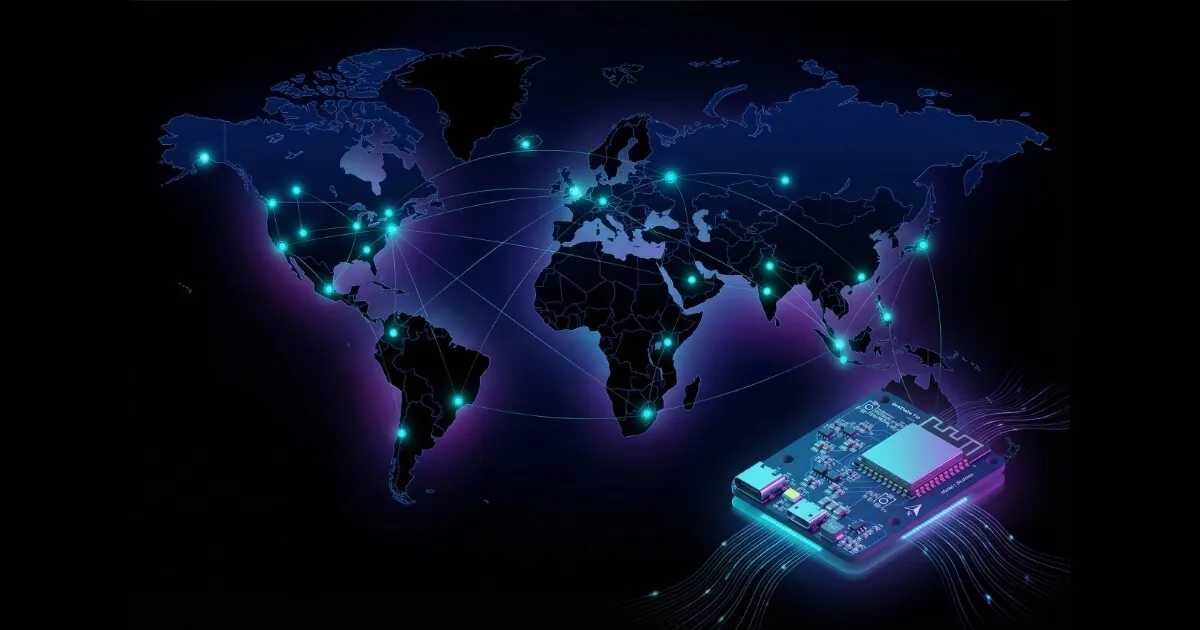
Peak Ground Acceleration (PGA) measures how hard the ground jerks during an earthquake, expressed in g-units (1 g = 9.81 m/s²). Unlike magnitude — which describes total energy at the source — PGA is a local intensity measure: it tells you exactly how strong the shaking was at your specific location. MEMS accelerometers like the LSM6DSO can detect earthquakes at instrumental intensity IV and above (roughly 0.003 g). The GeoShake T1 uses an ESP32-S3 microcontroller with four LSM6DSO sensors arranged in a quad configuration, configured for a 104 Hz output data rate (~109 Hz effective) across a ±2 g range. It applies the STA/LTA (Short-Term Average / Long-Term Average) algorithm to distinguish real seismic P-wave arrivals from vibration noise, then transmits PGA data via MQTT in milliseconds. While individual MEMS sensors are less sensitive than professional geophones, citizen science networks compensate through density — thousands of affordable sensors covering an area detect and triangulate epicenters faster than a few expensive instruments ever could.
For centuries, understanding earthquakes was the exclusive domain of scientists with massive, expensive equipment. Today, a revolution is underway in a basement, garage, or spare room near you. By combining powerful, affordable sensors with open-source ingenuity, citizen scientists and makers are building a new, hyper-local understanding of the ground beneath our feet. At the heart of this movement is a critical metric called Peak Ground Acceleration (PGA), and projects like GeoShake are putting the tools to measure it directly into your hands.
What is Peak Ground Acceleration (PGA) and Why Does It Matter?
When an earthquake strikes, the ground doesn't just move—it accelerates. Peak Ground Acceleration is precisely what it sounds like: the maximum ground acceleration recorded at a specific location during the quake. Measured in units of gravity (g), where 1 g equals 9.81 m/s², PGA tells you how hard the earth jerked, not just how far it moved.
Unlike the more familiar Richter or moment magnitude scales that describe the total energy released by an earthquake at its source, PGA is a local intensity measure. It answers a critical question: How hard did the ground shake right here? This makes it invaluable. Two towns an equal distance from the same earthquake can experience wildly different shaking—and therefore different damage based on local soil conditions. PGA captures that crucial, hyper-local detail.
For engineers, PGA is foundational. It's the key parameter used in seismic building codes and for plotting seismic hazard maps that guide construction. While the magnitude tells you the size of the event, PGA helps predict its impact on the human-made environment. For moderate quakes, PGA is a good determinant of potential damage; for severe ones, the duration of shaking and peak ground velocity also become critically important.

PGA in Action: From Imperceptible to Destructive
To understand what PGA values mean in the real world, consider this scale of shaking:
| Instrumental Intensity | PGA (in g) | Perceived Shaking | Potential Damage |
|---|---|---|---|
| I | < 0.0005 | Not felt | None |
| IV | 0.003 – 0.028 | Light | None |
| VI | 0.115 – 0.215 | Strong | Light |
| VIII | 0.401 – 0.747 | Severe | Moderate to Heavy |
| X+ | > 1.39 | Extreme | Very Heavy |
Historical records show the astonishing range of PGA. The 2008 Iwate–Miyagi earthquake in Japan registered a staggering 4.36 g, while the massive 9.2 magnitude 1964 Alaska earthquake produced a PGA of about 0.18 g at a recording site. This highlights a key point: a lower-magnitude but shallow quake close to a sensor can produce a much higher PGA than a gigantic but distant or deep quake.
The GeoShake Sensor: An Open-Source Seismic Sentinel
This is where the DIY seismograph dream becomes a sophisticated reality. The GeoShake T1 earthquake sensor is not a toy; it's a precision instrument built on a philosophy of open-source seismology and designed for real-time seismic monitoring.

Precision Engineering on a Maker Budget
At its core, GeoShake leverages the powerful ESP32-S3 microcontroller, a favorite in the IoT world for its robust Wi-Fi capabilities and processing power. Its true secret, however, lies in its sensing array: four LSM6DSO 3-axis accelerometers arranged in a precise quad-sensor configuration.
Why four identical sensors? This sophisticated approach is all about noise reduction. By comparing and averaging data from all four sensors, the unit can computationally distinguish between meaningful seismic signals and local "noise" like passing trucks, slamming doors, or household vibrations. It's the technological embodiment of the "trained guard dog" analogy ignoring the routine disturbances while staying keenly alert for the real event.
Capabilities That Rival Professional Gear
GeoShake runs its accelerometers at a 104 Hz output data rate (typically ~109 Hz effective) with ±2 g full scale. The sensors' optional second-stage low-pass filter is deliberately left disabled, so the channel keeps its full anti-alias bandwidth of roughly half the sample rate; the detector then applies its own single-pole high-pass at about 0.2 Hz to strip gravity and DC drift before analysis. That combination gives ample temporal resolution for wave analysis while keeping the instrument linear through strong shaking. This setup allows it to perform two advanced functions:
- Measure Key Metrics: It calculates both PGA (Peak Ground Acceleration) and Arias Intensity (a measure related to the total energy in the shaking).
- Distinguish Seismic Waves: It can identify the difference between the fast-moving, less-damaging P-waves (Primary) and the slower, more destructive S-waves (Secondary). This capability is the foundational principle behind earthquake early warning systems—a few seconds of warning that can be lifesaving.
Built for Reliable, Real-World Monitoring
Any sensor is only as good as its data connection. GeoShake is built for resilience:
- Real-Time Network: It streams data over MQTT to GeoShake's own EMQX broker, providing a live feed of ground motion.
- Never Misses a Beat: Its "Offline Ring Buffer" is a critical feature. If the internet connection drops, the sensor continues sampling and stores the data locally in a loop, preserving it until the connection is restored. This ensures that an earthquake won't go unrecorded just because your Wi-Fi had a moment.

The Mission: Build a Global, Open-Source Network
The vision of GeoShake extends far beyond a single clever device. It's about building a community. This is a fully open-source project. You have two paths:
- The DIY Route: Download the open source firmware and the 3D-printable enclosure files. Solder the components, flash the ESP32, and calibrate your sensor. It's a deeply rewarding ESP32 IoT project for anyone interested in electronics, coding, or earth science.
- The Ready-to-Deploy Route: Purchase a pre-assembled and calibrated unit, connect it to power and Wi-Fi, and you're contributing data in minutes.
Every deployed sensor, whether on a kitchen counter in California or a bookshelf in Greece, becomes a node in a growing, distributed seismic network. This dense mesh of sensors can provide a richer, more detailed picture of ground motion than sparse professional networks alone can achieve, contributing to community awareness and scientific research.

Join the Ground-Shaking Movement
The era of passive observation is over. Today, you can actively participate in understanding the dynamic planet we live on. By measuring PGA and sharing that data, you're not just building a gadget you're contributing to a collective awareness that makes us all more resilient.
Visit geoshake.org today. Explore the open-source documentation, join the community forum, and learn how you can start building your own sensor or order a unit to get started immediately. If you would rather build than buy, the ESP32 earthquake sensor board (Maker Edition) is the same electronics without the enclosure, and our ESP32 vs Raspberry Pi comparison explains why the network runs on ESP32. Let's shake things up, together.
Are you ready to listen to the Earth and contribute to a global understanding of seismic activity? The blueprint is open, the community is waiting, and the ground is always moving.
Ready to get your own sensor?
Join the GeoShake network with a pre-assembled T1 unit.
Sources & References
- USGS Earthquake Hazards Program — Peak Ground Acceleration — USGS reference for PGA definitions, ShakeMap methodology, and ground motion measurement standards
- STMicroelectronics LSM6DSO Datasheet — Official datasheet for the 6-axis iNEMO inertial module (accelerometer + gyroscope) used in the GeoShake T1, including noise density and full-scale range specifications
- Espressif ESP32-S3 Technical Reference Manual — Microcontroller specifications for the processing platform used in GeoShake T1
- USGS — Modified Mercalli Intensity Scale — Official USGS description of the MMI scale, correlating PGA values to felt shaking intensity and damage levels
- Allen, R.V. (1978) "Automatic earthquake recognition and timing from single traces." Bulletin of the Seismological Society of America, 68(5), 1521–1532 — Original paper introducing the STA/LTA (Short-Term Average / Long-Term Average) P-wave detection algorithm
Correction
11 August 2026. An earlier version of this article
stated that the GeoShake T1 samples "at 100 Hz with a 23 Hz hardware low-pass filter." That was
wrong. The firmware configures the LSM6DSO accelerometers with
CTRL1_XL = 0x40 — a 104 Hz output data rate at ±2 g, with the optional
second-stage low-pass filter (LPF2) disabled. Field measurements independently confirm
it: the observed noise floor matches the wider bandwidth that follows from LPF2 being off, and
would be roughly a third lower had the 23 Hz filter actually been engaged. The text above has
been corrected. Our thanks to the internal review that caught it.
Get earthquake insights in your inbox
One short email a month — new guides, network updates, real detection stories. No spam, unsubscribe anytime.